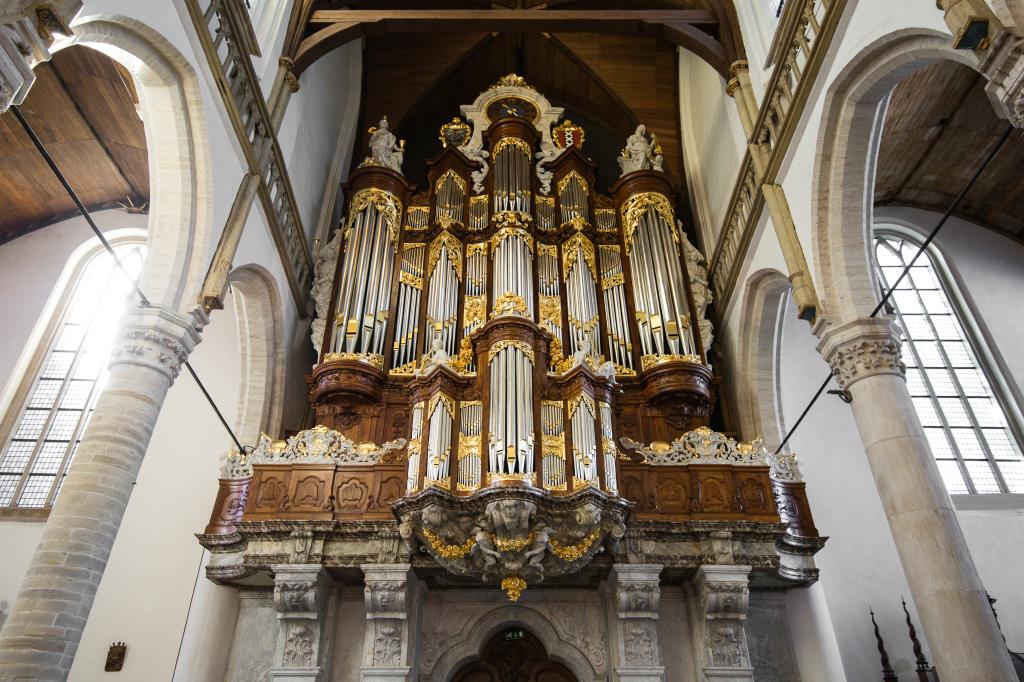
The Oude Kerk has two monumental organs, and houses a small Italian organ and a choir organ, all of which can be heard during concerts and church services. On the west side, the impressive Vater-Müller organ (1726/1742) occupies a prominent place. The organ owes its name to the organ builders Christian Vater and Johann Caspar Müller.
The Oude Kerk has a long organ tradition. Already in the 15th century, an organ hung against the west wall of the ship (the tower wall). A new instrument was installed in 1539. The famous composer Jan Pieterszoon Sweelinck played the organ between 1577 and 1621. It would remain, with some modifications and renovations, until 1724. In that year, the organ builder Christian Vater was commissioned to build a new organ. Shortly after the completion of the Vater organ, the church tower began to show serious signs of subsidence. Due to the danger of collapse, the entire organ had to be dismantled. After the foundation of the tower was restored, Johann Caspar Müller was instructed to replace the organ, with some changes to the organ. In 1870 an important and extensive restoration took place. The quality of the work then delivered by J. Bätz & Co. (C.G.F. Witte) was of such high quality that in the twentieth century there was a battle between experts about how the organ should be restored: oriented by its status of the early 18th or late 19th centuries. The consequence of this was that the organ had to wait a long time for a new restoration, which was carried out in the years 2015-2019, by the Reil company in Heerde. The Vater-Müller organ is still highly regarded today.